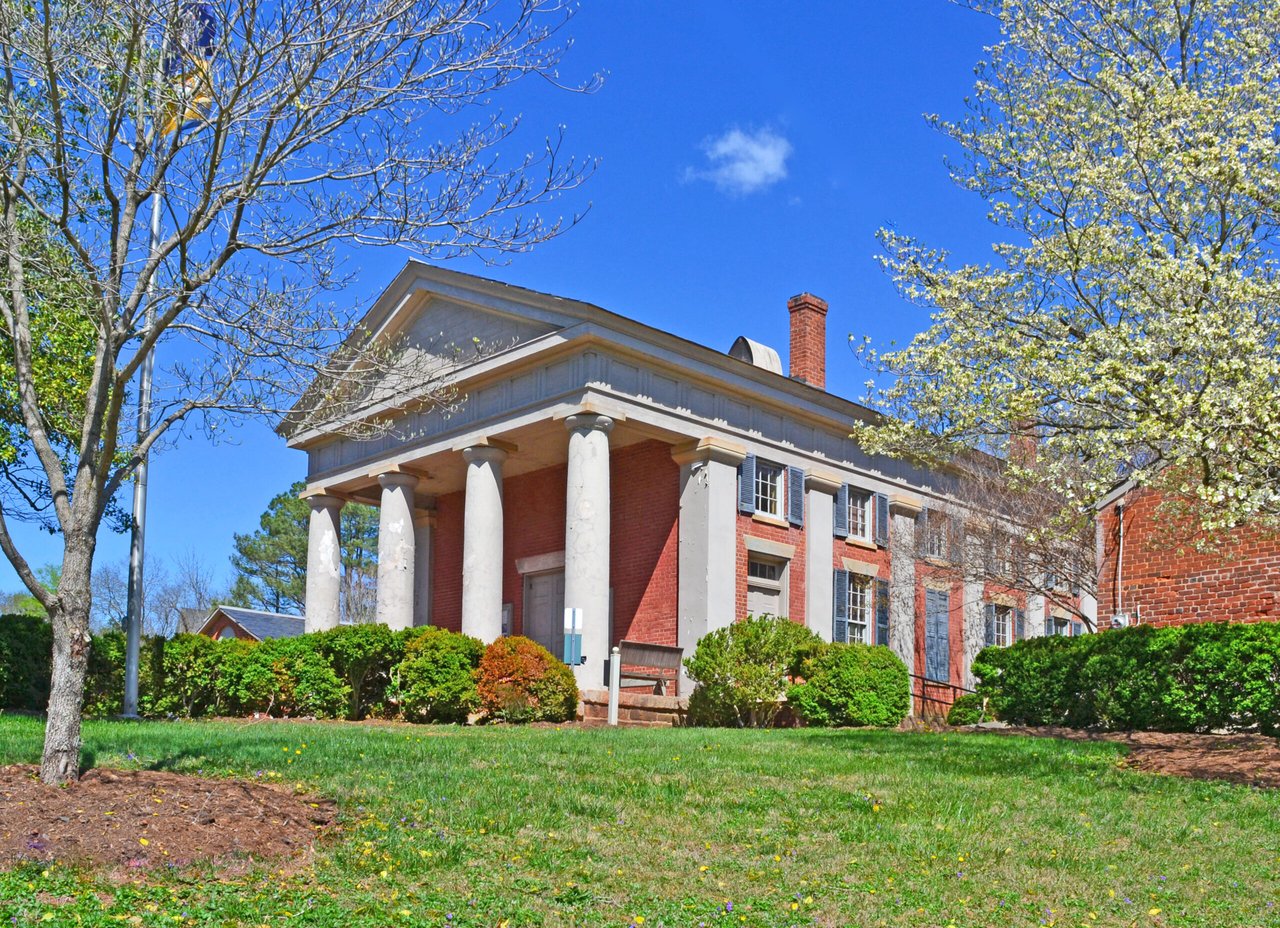
The Acropolis of Palmyra: Fluvanna County's Extraordinary Courthouse
By Peter Wiley | Corcoran Wiley | Charlottesville, VA
I grew up in the shadow of one of the Commonwealth’s most perfect pieces of architecture. No, not Monticello, but the Fluvanna County courthouse, a two-story brick temple with four Greek Doric columns, a building so precisely composed and so quietly confident in its setting that it stops you. It doesn't look like a county courthouse. It looks like something that belongs on the Athenian Acropolis. Which is, in fact, exactly what one of America's preeminent architectural historians once said about it.
The Fluvanna County Courthouse is one of the most architecturally significant public buildings in Virginia. That's not local boosterism, it's the considered verdict of scholars, preservation organizations, and the National Register of Historic Places, which added the courthouse and its surrounding historic district to its rolls in 1971. Understanding why requires a short trip into the world of early American architecture, a remarkable man named John Hartwell Cocke, and a county that punched well above its weight in the early decades of the American republic.
The Building and Its Designer
Fluvanna County was carved out of Albemarle County in 1777, with the county seat initially located on the southeast side of the Rivanna River. By the late 1820s, the existing courthouse was out of repair and inconveniently situated, and in 1828 the Virginia General Assembly authorized a vote to relocate the county seat. Palmyra won the poll, and the county proceeded to build.
The man who shaped what that building would become was General John Hartwell Cocke of Bremo Plantation, one of the five commissioners charged with planning the new courthouse and jail. Cocke was a remarkable figure, a brigadier general in the War of 1812, a co-founder of the University of Virginia alongside Thomas Jefferson, a progressive farmer and reformer who opposed tobacco cultivation and advocated for temperance. He was also a deeply serious amateur architect who had already designed the extraordinary Palladian mansion at Upper Bremo with master builder John Neilson, the same craftsman who had worked with Jefferson at Monticello and Montpelier.
Cocke's courthouse, completed in 1831 under the supervision of contractor Walker Timberlake, made an architectural statement that was genuinely bold for its time. While Jefferson and most of the Virginia courthouse builders of the era worked in the Roman classical tradition with the round arches, smooth columns, and refined proportions of Roman antiquity that Jefferson had championed, Cocke turned instead to the Greek. The Fluvanna County Courthouse is Virginia's earliest courthouse to employ the Greek classical order, specifically the Greek Doric, and that choice set it apart immediately and permanently from everything around it.
An Architectural Achievement
The distinction between Greek and Roman Doric is subtle but meaningful to a trained eye. Greek Doric columns, unlike their Roman counterparts, have no base — they rise directly from the floor or platform, a feature that architectural historians called "going barefoot." The capitals are simple and conical, the proportions more severe and muscular than the refined elegance of Roman work. Architectural historian Talbot Hamlin, one of the foremost scholars of Greek Revival architecture in America, coined the phrase that has defined the building ever since: he called it the "Acropolis of Palmyra."
The building itself is a two-story red brick structure in the form of a tetrastyle temple — four columns supporting a full pediment at the roofline — five bays deep, facing south. Stone is used throughout with notable richness: for the column and pilaster capitals, the steps, the water table, window sills, and lintels. Two levels of windows on the sides and three arched windows at the rear are separated by pilasters. Inside, the original courtroom retains its original balustrade around the judge's bench — the kind of interior integrity that is extraordinarily rare in a building nearly two centuries old.
Above the entrance, cut into the stone lintel, is an inscription that may be the finest sentence on any public building in Virginia: "THE MAXIM HELD SACRED BY EVERY FREE PEOPLE — OBEY THE LAWS."
That inscription alone is worth a detour.
A Building That Shaped What Came After
What makes the Fluvanna courthouse historically important beyond its own considerable beauty is what it started. It was the first Virginia courthouse to use the Greek order at a moment when the new American republic was searching for an architectural language that could express its democratic ideals in built form. Jefferson had championed the Roman classical. The Virginia State Capitol in Richmond is modeled on the Maison Carrée in Nîmes, but a new generation of architects and civic builders was turning to Greece, whose democracy was the more direct ancestor of the American experiment.
Fluvanna's courthouse preceded that turn and helped establish it. As one preservation expert put it recently: "It is the first of the Virginia courthouses to use the Greek order, setting a new example for courthouses to follow here in Virginia and across the nation." Cocke's willingness to depart from the Roman idiom favored by his mentor Jefferson was an act of architectural independence that resonated well beyond Palmyra.
The construction itself carries a history that the county has recently worked to acknowledge fully. The labor that built the courthouse was performed in significant part by enslaved craftsmen from Bremo Plantation — skilled workers whose contributions were long unrecorded. Recent historical research by the Fluvanna County Historical Society has begun to document those contributions and, in some cases, to recover individual names. Two current members of the society's board of directors are direct descendants of enslaved families from Bremo. "This courthouse truly belongs to the entire community," said Fluvanna County Board of Supervisors Chair Mozell Booker when the county received state funding for restoration.
The Historic District Today
The courthouse anchors a small but remarkably intact historic district in downtown Palmyra. The stone jail, built in 1829 by John G. Hughes and reflecting the same distinctive masonry character as the farm buildings at Bremo, now serves as the Fluvanna County Historical Society's museum. A small lawyer's office dating from around 1830 served as the county library. Together, the cluster of buildings represents one of the most complete antebellum courthouse complexes in Virginia. The courthouse itself remains one of the state's very few antebellum courthouses to survive without additions and with its original interior arrangement largely intact.
The building has required attention in recent years — a major structural component of the roof failed, prompting an extensive restoration effort. The Fluvanna County Historical Society, the county Board of Supervisors, and the Virginia General Assembly collaborated to secure more than $750,000 in combined state and local funding for the restoration, a measure of how seriously this community takes its extraordinary inheritance.
Why This Matters for Fluvanna County
At Corcoran Wiley, our roots run deep in Fluvanna County. Not only were my brother and I raised there, we represent buyers and sellers on the farms, river properties, and residential parcels that make this county one of the most appealing in the Central Virginia region. Fluvanna is closer to Charlottesville and UVA than most assume. The Rivanna and James Rivers run through it, crossing the rolling piedmont, creating a character that feels genuinely rural within an easy drive to Charlottesville or the west end of Richmond.
If you haven't stopped in Palmyra to see the courthouse, you should. Stand on the steps. Read the lintel. It's one of the finest things in Central Virginia.
Peter Wiley is a Broker/Owner at Corcoran Wiley, specializing in farms, estates, and high-end residential properties throughout Central Virginia. With offices in Charlottesville and Orange, Corcoran Wiley serves buyers and sellers across Albemarle, Orange, Madison, Greene, Fluvanna, Louisa, and Nelson Counties.
Contact us | View listings in Fluvanna County | 434.293.3900
Fluvanna County Virginia history, Fluvanna County Courthouse Palmyra, Greek Revival architecture Virginia, John Hartwell Cocke Bremo Plantation, historic courthouses Virginia, Palmyra Virginia historic district, Fluvanna County real estate, farm property Fluvanna County, Corcoran Wiley Central Virginia